AI Literacy for Kids: What Singapore Schools Teach

Your child is almost certainly using generative AI already, for homework help, image generation, or just curiosity. MOE provides self-paced AI literacy modules through the Student Learning Space, built on a framework it calls the Four Learns. What those modules do not do is sit a child down and make them catch an AI being confidently wrong. That gap is what AI literacy actually means, and it is teachable.
We run an eight-class block on exactly this, so some of what follows is from the classroom. The rest is from what MOE publishes.
In short
MOE offers self-paced AI literacy modules on SLS, covering learning about AI, using AI features, and responsible use
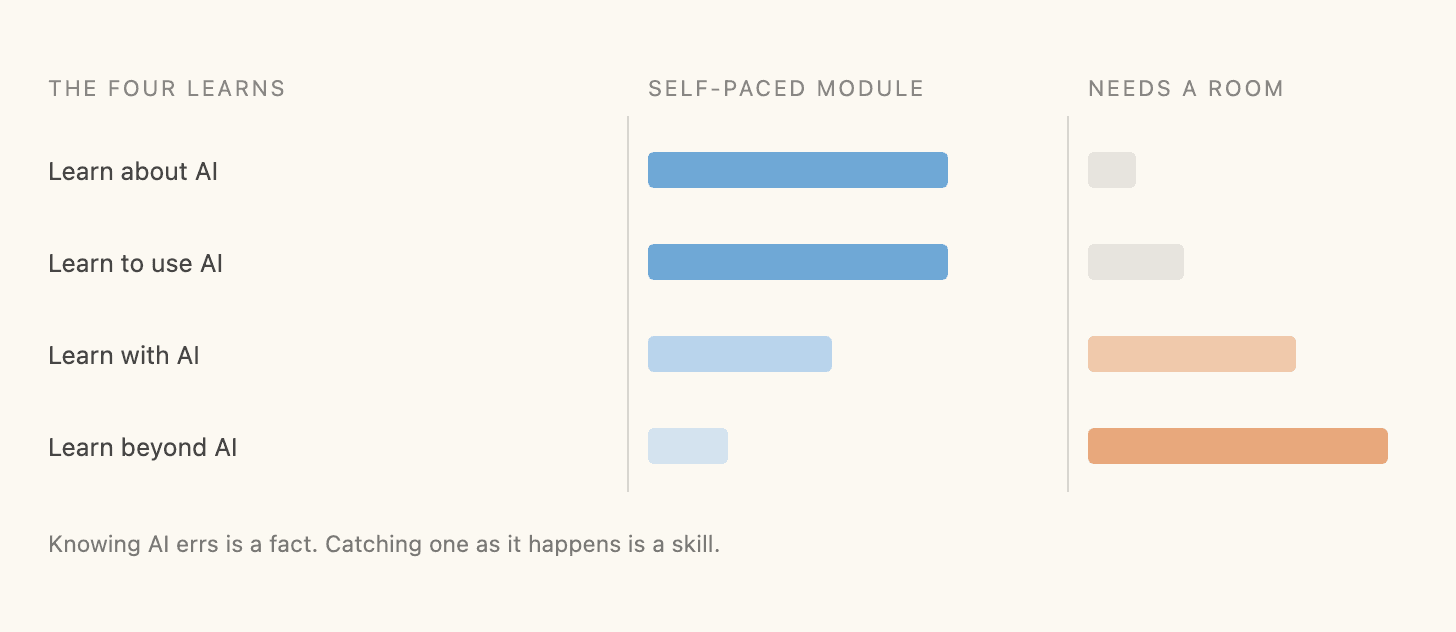
The framework is the Four Learns: learn about AI, to use AI, with AI, and beyond AI
Self-paced means your child completes it alone, at a screen, without a teacher watching them get it wrong
The skills that matter most are spotting a hallucination, recognising bias, and knowing when not to trust the answer
Most "AI for kids" classes in Singapore teach AI as a coding topic. That is a different subject
Start with what school covers, because it is more than most parents realise and less than the marketing suggests.
MOE publishes that "self-paced modules on AI literacy are available on SLS", covering three areas: learning about AI, using the AI-enabled features inside SLS, and the responsible use of AI for learning (MOE).
The pedagogical frame is what MOE calls the Four Learns: learn about AI, learn to use AI, learn with AI, and learn beyond AI. It is a genuinely good structure, and it is more thought-through than anything a robotics centre invented.
MOE also sets out its commitments plainly. AI in education "must benefit students' learning and development", must be "purposeful and intentional", and "age- and developmentally appropriate, safe, and responsible" (MOE).
MOE is also careful about when these tools help. Its SLS guidance states that "when used appropriately, these tools can support students in their learning when students have mastered basic concepts and thinking skills" (MOE SLS). That condition, after mastering the basics, is the part most coverage skips. MOE also publishes a parent's guide to generative AI, which is worth asking your child's school for.
Two honest observations. Self-paced means alone, at a screen, in a child's own time. And MOE does not publish the year levels or hours involved, so we cannot tell you how much time your child will actually spend on it.
Here is the thing a module cannot easily do.
Understanding that AI sometimes makes things up is a fact you can read in a paragraph. Catching it happening, in the moment, on a topic you half-know, is a skill. Those are not the same, and only the second one protects a child.
The same is true of bias. A child can be told that AI reflects the data it was trained on. That is different from asking an image generator for "a scientist" ten times and noticing what comes back.
In a classroom you can put a wrong answer in front of a child and watch them accept it. Then do it again, and watch them start to check. That loop is the whole subject, and it needs someone in the room.
Our entry block is eight classes of two hours, sixteen contact hours, for P4 to P6. No prior experience needed.
By the end of it, a child can:
Explain what AI and generative AI actually are, and are not
Write and refine prompts to get a specific result, rather than accepting the first output
Spot AI-generated content, bias, and hallucinations, and say when not to trust an answer
Apply a simple framework for using AI responsibly at school and at home
Build and present their own AI-powered project
The block ends in a showcase, assessed on four criteria: understanding, creativity, responsible use, and presentation. A child takes home a finished project and a certificate.
On safety, because it is the first question parents ask. All tools are accessed through supervised class accounts. No personal data goes into third-party tools, which keeps the block aligned with PDPA. That is a rule we wrote down before we taught the first class.
This is worth being precise about rather than dismissive.
Singapore has plenty of AI provision for children now, and some of it is good. SGInnovate runs an industry immersion camp. Several coding academies teach machine learning projects, AI-assisted coding, and Python for data science. One centre has launched the LEGO Computer Science and AI curriculum, which is the successor to the SPIKE range.
Nearly all of it teaches AI as a thing you build with. That is a legitimate and useful subject, and we teach it too further up our own ladder.
It is not the same as AI as a thing you evaluate. A child who can train an image classifier has learned something real, and may still take a chatbot's confident wrong answer at face value.
If your child is going to use AI daily for the next decade, and they are, the evaluating skill is the one with the longer half-life.
None of this requires a class.
Ask it something you already know well. Your job, your hometown, a hobby. Let your child watch you catch an error. That single demonstration does more than any explanation.
Ask the same question twice. Different answers are a useful shock.
Ask for sources, then check one. Often the source will not say what the answer claims it says.
Generate an image of a common role. Doctor, scientist, teacher. Do it several times. Talk about what appears and what does not.
Agree a rule together about homework, and write it down. A rule a child helped set is one they will follow.
If you do those five things you have covered most of what matters, and you have done it in a fortnight of dinner-table conversation.
A fair question, given we are a robotics centre.
The honest connection is narrow. Robotics teaches a child to find the fault, break a problem into steps, and change one thing at a time. That habit transfers usefully to interrogating an AI answer rather than accepting it.
The broader claim, that robotics makes children better at evaluating AI, is not something we can evidence, and we would rather not imply it. We have written separately about what the research on robotics actually supports, including the parts that do not help us.
Worth knowing if secondary school admission is on your mind.
MOE lists science, mathematics and engineering among the DSA-Sec talent areas. A finished AI project with a certificate is a legitimate portfolio entry, and for many children it is the first one they own outright.
It is not a ticket. What DSA schools weigh is sustained work a child can explain, built over years. One project in P6 does not change an application, which is the same thing we say about robotics and coding for DSA.
About Champs Robotics. We run LEGO robotics, coding, 3D printing and AI literacy at 12A Kensington Park Road, Serangoon Gardens. Our AI programme runs as eight-class blocks for P4 to P6.
What age should kids start coding, and what MOE's Code for Fun actually covers
What robotics classes cost in Singapore, including AI and competition tracks
What the evidence supports about robotics and child development
It is more fun than it sounds, and considerably more useful than being told AI makes mistakes. Book a free trial class and see what your child catches.
What is AI literacy? Understanding what AI is and is not, using it effectively, recognising when its output is wrong or biased, and applying rules for responsible use. MOE frames it as the Four Learns: learn about AI, to use AI, with AI, and beyond AI.
Does school already teach my child about AI? Partly. MOE provides self-paced AI literacy modules through SLS covering how AI works, using AI features in SLS, and responsible use. MOE does not publish year levels or hours, so how much time your child spends on it is not clear.
At what age can a child learn AI literacy? Our own block is built for P4 to P6, roughly ages 10 to 12, because it needs enough reading fluency to evaluate an answer. Younger children can use AI tools with an adult, but the evaluating skill arrives later.
Is it safe for my child to use AI tools? With supervision and rules, yes. We use supervised class accounts and put no personal data into third-party tools, which keeps things aligned with PDPA. At home, the equivalent is a shared account and an agreed rule about homework.
Is AI literacy the same as learning to code with AI? No, and the difference matters. Most AI classes for children teach building with AI, which is machine learning and AI-assisted coding. AI literacy is about evaluating what AI produces. Both are worth doing; only one of them protects a child from a confident wrong answer.