What Age Should Kids Start Coding? Singapore Guide

Short answer: most children can handle real programming concepts from around age 7. But in Singapore the more useful question is not "how old is my child", it's "where does my child sit relative to the school pathway." Your child will get roughly ten hours of coding at school, somewhere in upper primary. If robotics or coding is going to matter for a DSA application, the portfolio has to be built well before P6. Those two facts move the decision far more than a birthday does.
We teach this every week in Serangoon Gardens, to children from age six upward. What follows is what we actually see in the classroom, set against what the Ministry of Education and Science Centre Singapore publish about the pathway.
In short
Most children handle real programming from age 7-8; six-year-olds can start, but they're buying an introduction rather than progress.
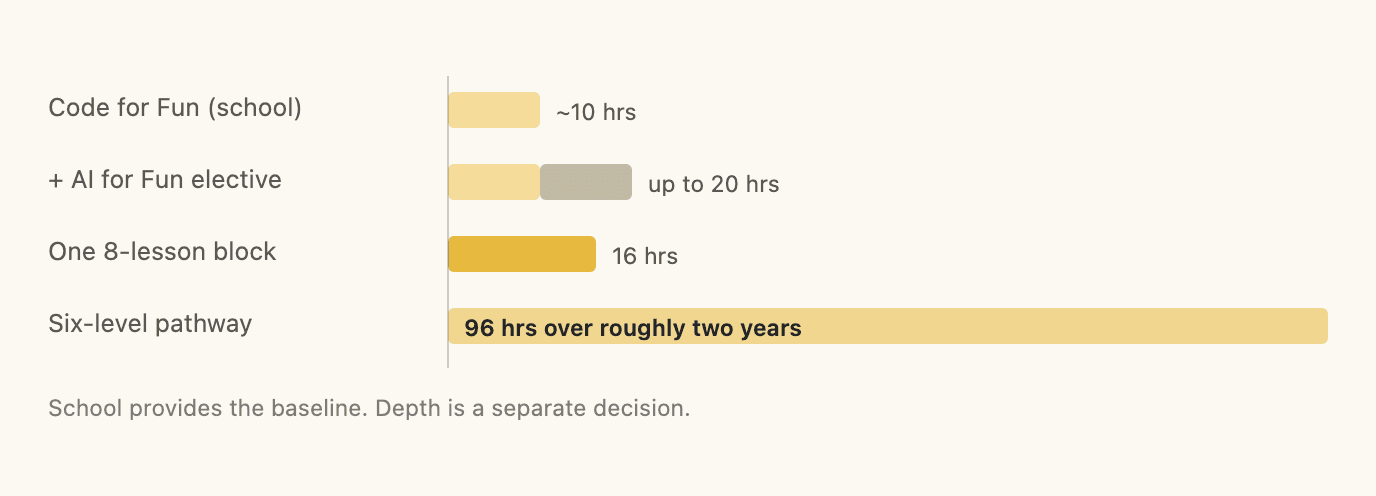
School provides roughly ten hours of coding in total, via MOE's Code for Fun. Depth has to come from elsewhere.
If DSA matters to you, the portfolio is built in P3-P5, not P6. That's the only genuinely time-sensitive factor.
Starting at 10, 12 or 14 costs your child nothing.
This is the part most parents don't have a clear number for.
Singapore does not teach coding as a standalone subject. In a 2020 parliamentary reply, MOE set out the reasoning plainly: the priority is "the underlying skills such as computational thinking, problem solving, logical reasoning and data handling" rather than programming itself (MOE, 4 Sep 2020). Exposure to actual code comes through Code for Fun, run with IMDA.
How much exposure? When MDDI announced the new AI for Fun modules in October 2024, it described them as five to ten-hour electives building on the "existing 10-hour foundational coding instruction covering variables, loops, and functions" (MDDI, 1 Oct 2024).
Ten hours. That is the national baseline, and it is genuinely well designed for what it sets out to do. Every child touches variables, loops and functions before leaving primary school.
It is also about one school term of a weekly enrichment class. If you want your child to have more than an introduction, the depth comes from somewhere else. That is the honest case for enrichment, and it is worth being clear-eyed about: not because school is failing, but because ten hours is an introduction by design.
By around seven, most children have four things at once that make programming click rather than frustrate.
They can hold an if-then relationship in their head and predict what will happen before it happens. They can read an instruction on screen without an adult decoding it. They can stay with a problem past the first failure. And they have started treating a symbol as standing for an action, which is what a code block is.
Take any one of those away and the lesson changes character. A child who cannot yet read independently spends the hour waiting for a teacher instead of iterating. A child who cannot tolerate a failed run stops after the second attempt.
The age bands used by the National Robotics Competition line up with this. Science Centre Singapore, which has run NRC since 1999 with MOE support, opens its Regular Category at Lower Primary for 7 to 9-year-olds, with a separate Preschool division for ages 5 to 6 (Science Centre Singapore). Seven is where the national competition structure starts treating children as builders rather than players.
Our own entry level takes children from six, and the difference across those two years is stark enough that we plan for it.
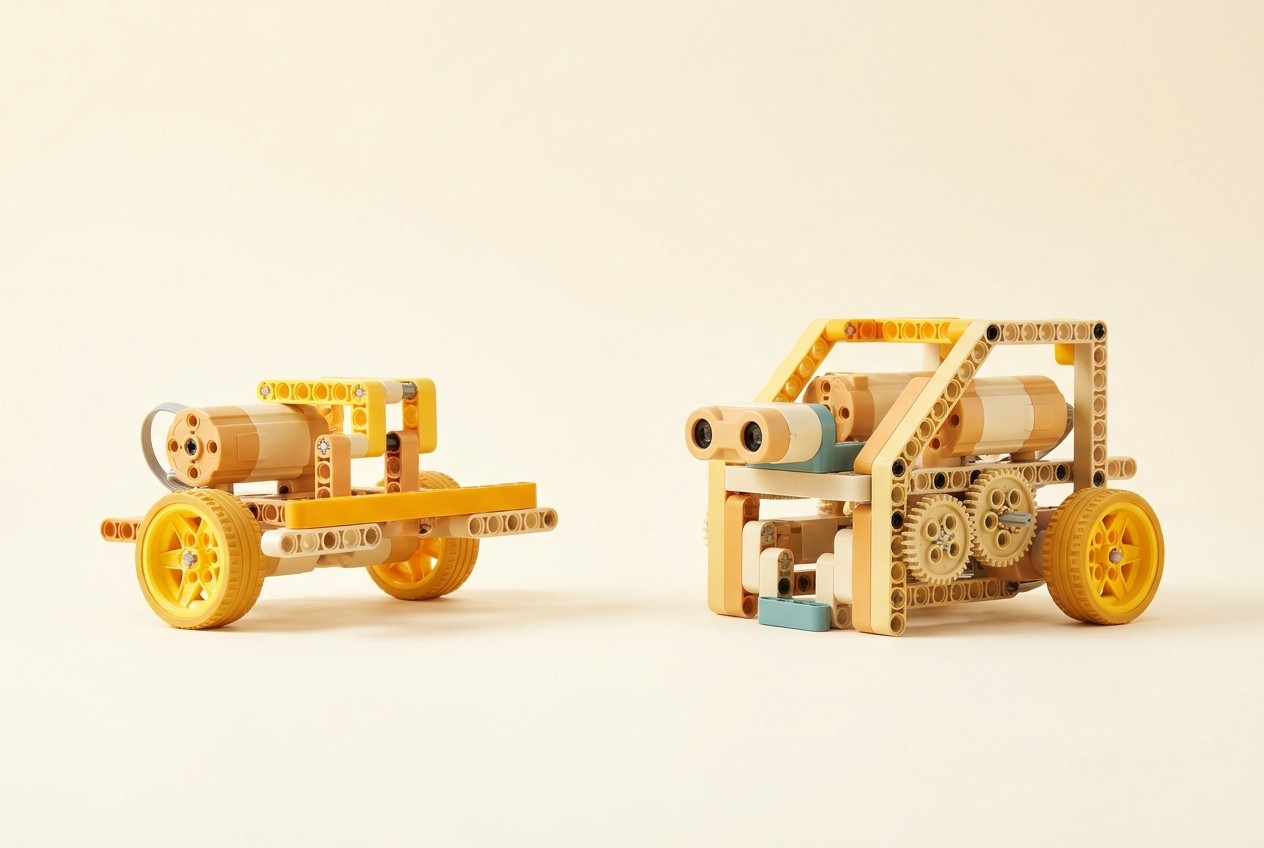
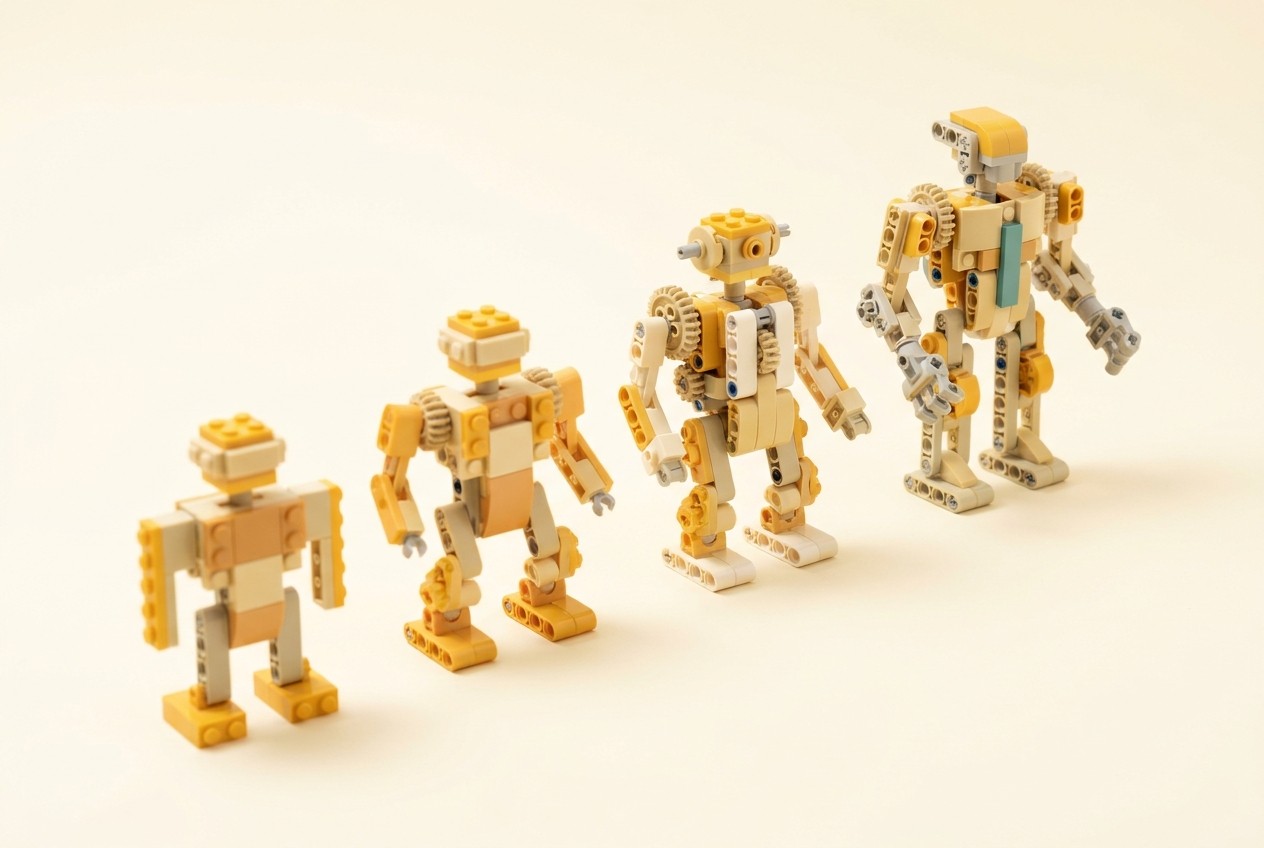
A six-year-old in Level 1 builds a hopping racer and a robot that cleans a table, and programs it to move at a set speed and direction. They need the build guide read aloud, and they need an adult nearby when a beam doesn't seat properly. What they get out of it is real: by the end of the level they can drive a robot around obstacles under their own control, and they have learned that a motor and a sensor are things you use, not things you're told about.
An eight-year-old covering the same material works from the guide alone, and spends the time they save on the interesting part, changing the program to see what breaks. By Level 3 they are building a sumo robot with two colour sensors and writing their own reusable blocks of code.
Both are worthwhile. But a six-year-old is buying an introduction, and an eight-year-old is buying progress. Parents should know which one they're paying for.
Age | Typically ready for | What they still need |
|---|---|---|
5-6 | Sequencing games, guided building, unplugged activities | An adult reading every step; short sessions |
7-8 | Block coding, sensors, first independent debugging | Help when a build fails mechanically |
9-10 | Multi-step projects, own reusable code blocks | Prompting to plan before building |
11-12 | Transition to Python, competition work | Little; this is where independence lands |
13+ | Text languages, own projects end to end | Direction rather than instruction |
Here is where the Singapore answer diverges sharply from the generic one.
Direct School Admission lets a student enter a secondary school on interest and aptitude rather than PSLE score alone. MOE lists "science, mathematics and engineering" among the recognised talent areas (MOE DSA-Sec). Robotics and coding sit inside that category.
The 2026 exercise runs from 6 May to 2 June 2026, with outcomes by 28 August 2026. Applications are made in P6.
Which means the portfolio behind the application is not built in P6. It is built in the years before it. Schools assessing a DSA applicant are looking for sustained involvement and evidence the child can explain their own work. A P6 sprint reads as exactly what it is.
If DSA is anywhere in your thinking, work backwards. A child starting in P3 has three years to accumulate finished projects, a competition entry or two, and enough fluency to talk about a design decision without a script. A child starting in P6 has a hobby, which is a fine thing to have, but not a portfolio.
If DSA is not in your thinking, this section doesn't apply, and starting at 9 or 10 costs your child nothing at all.
Claims about robotics and child development get overstated in this industry, ours included. So it's worth being precise about what the evidence actually shows.
A 2024 meta-analysis in Heliyon pooled ten studies on educational robotics and computational thinking in early childhood, and found a large positive effect, a standardised mean difference of 0.93, with every one of the ten studies pointing the same direction (Alonso-Garcia et al., 2024, Heliyon 10(13), e33249).
Two honest caveats. Ten studies is a small pool. And the authors report high heterogeneity between them (I² = 80.7%), which means the size of the benefit varied a lot depending on how the teaching was done. The effect is real; the magnitude in any particular classroom depends on that classroom.
What the evidence does not establish is the thing you'll see claimed most often, that early coding makes children better at school generally, or raises maths grades. Treat any centre promising that, including one down the road from us, as selling ahead of the data.
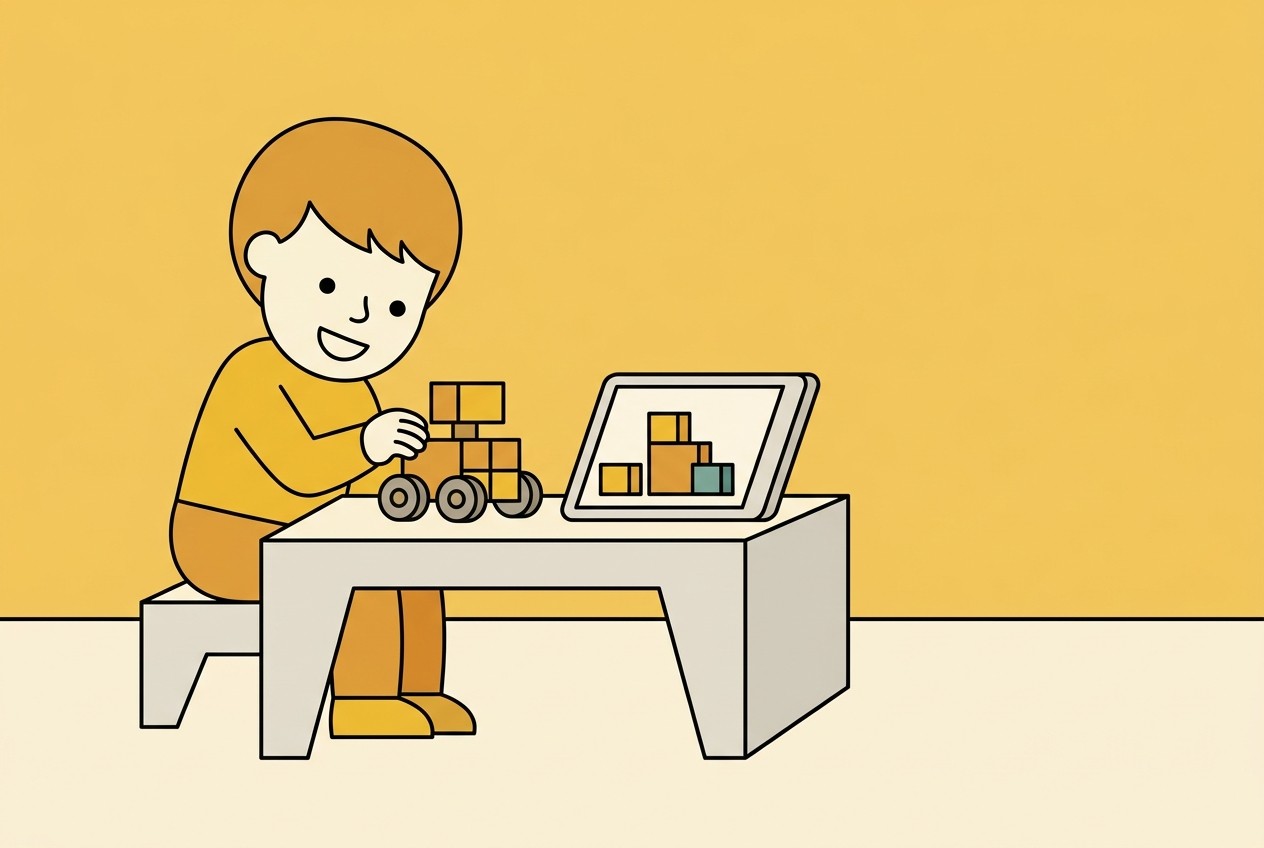
Age is a proxy. These are the signals worth more than the number:
They ask how something works, unprompted, and stay for the answer.
They enjoy puzzles or construction toys, the same loop of try, fail, adjust.
They can navigate a screen and follow instructions on it without hand-holding.
When something doesn't work, their instinct is to change one thing and try again, rather than to stop.
They want to make things rather than only consume them.
Three or four of those, at almost any age from six upward, and your child will get something out of a class. Fewer than that at seven, and waiting six months costs nothing.
If your child is 10, 12 or 14 and has never written a line of code, nothing has been lost.
Older beginners move faster through the early material. The abstraction a seven-year-old works hard at is already available to them. In our own experience, a 12-year-old joining at Level 1 typically covers the first two levels in noticeably less time than a younger cohort, because the building is the only genuinely new part.
The real constraint on a late start isn't capability. It's the DSA calendar, and only if that pathway matters to you.
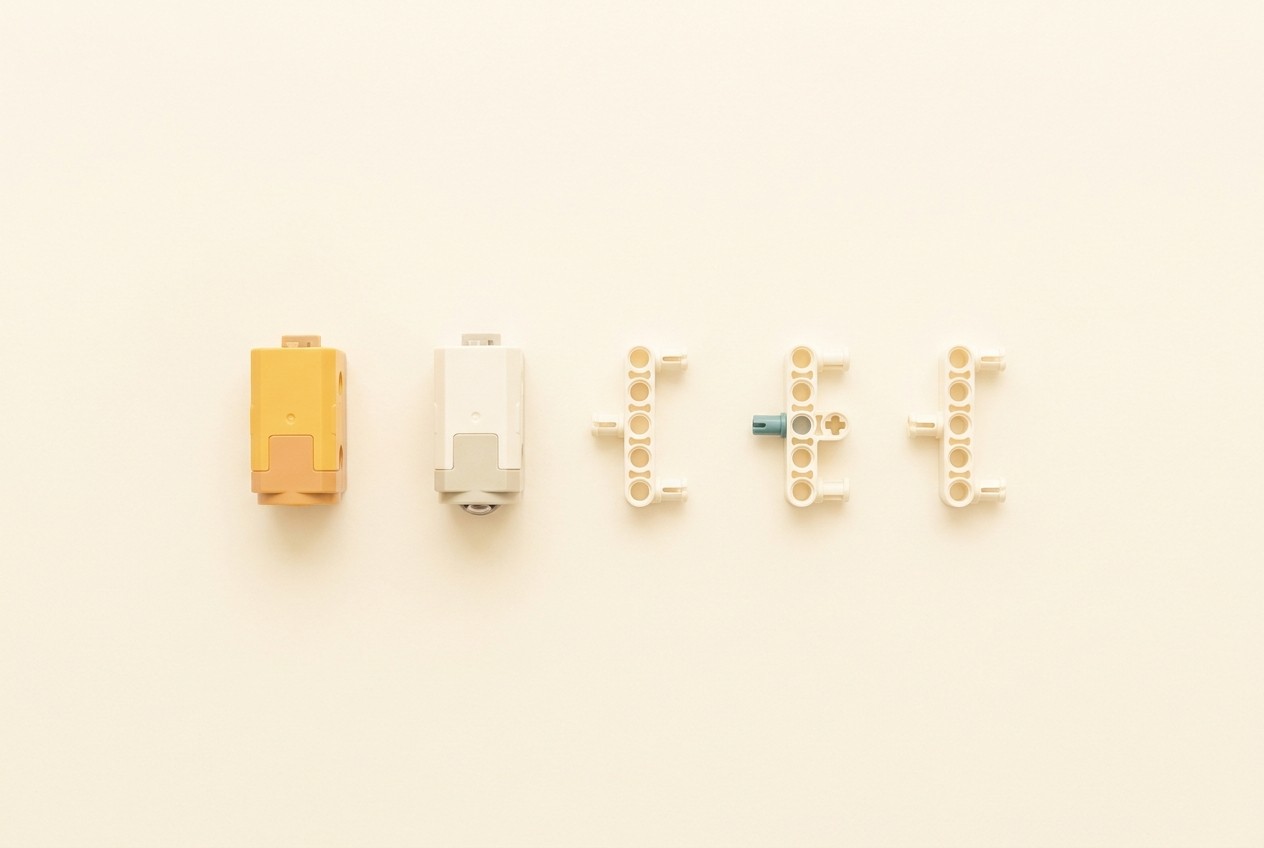
Ask what the child builds, by name. A centre that can tell you "a line-following robot in lesson four, a sumo robot with two colour sensors at Level 3" has a curriculum. A centre that says "fun, hands-on STEM learning" may not.
Ask about the assessment. A level that ends in something, whether a written and practical assessment, a certificate or a finished project, gives a child a reason to consolidate. Open-ended terms drift.
Ask the class size. Six and seven-year-olds need an adult within reach when a build fails. Ratios matter far more at the bottom of the age range than the top.
Ask how a child moves up. A programme with a defined ladder can tell you where your child will be in two years. One without will sell you the same term repeatedly.
Take the trial class. Watch whether your child is building or waiting.
For most Singaporean children, seven to eight is when coding stops being a game and starts being a skill. Start earlier if your child is unusually ready and you want the introduction; start later without worry if they're not. The one genuinely time-sensitive factor is DSA, and that clock starts in lower primary, not P6.
If you'd like to see where your child actually sits, the most reliable test is putting them in front of a robot for an hour. Our free trial class at Kensington Park Road does exactly that, and you'll know more from watching that hour than from any age chart, including this one.
About Champs Robotics. We run LEGO robotics, coding and 3D printing at 12A Kensington Park Road in Serangoon Gardens. Our robotics pathway runs six levels across roughly two years, eight two-hour lessons per level, each ending in an assessment and a certificate.
LEGO robotics for kids in Singapore, including what it costs and the 2026 kit changes
What the evidence actually supports about robotics and child development
Our competition track, if DSA is on your mind
Robotics and coding for DSA, and how the three-year runway works
What robotics classes cost in Singapore, with a full price breakdown
That's the normal position, and an age chart won't settle it. Put them in front of a robot for an hour and watch whether they build or wait. Book a free trial class and see what they make.
Can a 5-year-old learn to code? They can learn sequencing, pattern recognition and cause-and-effect through unplugged activities and block-based play, and NRC runs a Preschool division for ages 5 to 6. Formal programming, with reading and sustained debugging, generally waits until around 7.
Is 12 too late to start coding? No. Older beginners usually move through introductory material faster because the abstract reasoning is already in place. The only real deadline in the Singapore system is the DSA application window in P6.
Does school already teach my child coding? Partly. Code for Fun gives primary students around ten hours of foundational coding covering variables, loops and functions, with new AI for Fun electives added from 2025. It is an introduction rather than a full course.
Should my child do block coding or text coding first? Blocks first for most children under about 10. Blocks remove typing and syntax errors so the child works on logic. The transition to text-based languages such as Python usually lands well between 10 and 12.
Does robotics help with DSA? It can. MOE lists science, mathematics and engineering among DSA-Sec talent areas. What carries weight is sustained, demonstrable work the child can explain, which takes years to build, not months.