Robotics and Coding for DSA: What It's Worth

Robotics and coding are a recognised route into DSA-Sec, under the science, mathematics and engineering talent area. They work because the thing they produce is the thing schools weigh: finished builds, a record of work across years, and a child who can explain their own decisions out loud.
What that needs is a runway. Applications open in early May of P6, so the portfolio behind one is built across P3 to P5.
In short
MOE lists science, mathematics and engineering among DSA-Sec talent areas
Applications open early May of P6 and close early June, outcomes by late August
The portfolio is therefore built in P3 to P5, and three years is a real runway
What counts is sustained work a child can explain, which is what a build ladder produces
The coaches teaching it have judged and coached at national and international level
No centre can promise you a DSA outcome. Ours included
Direct School Admission lets a student enter a secondary school on interest and aptitude rather than PSLE score alone. MOE lists the recognised talent areas, and "science, mathematics and engineering" is one of them (MOE). Robotics and coding sit inside that category.
So the answer to "does robotics help with DSA" is yes, and the reason is specific. This is one of the few enrichment subjects where ordinary week-to-week work leaves behind evidence a panel can actually look at.
Most enrichment subjects leave a parent with nothing to show at the end of a term. Robotics is unusual in that regard.
It produces finished things. A robot that works is a demonstrable artefact. Your child can put it on a table, run it, and say what they changed to make it run.
It accumulates. A build ladder gives a child a visible record across years, which is the shape of evidence DSA panels are set up to read. Six intense months looks like six intense months.
It forces explanation. Separating a mechanical fault from a coding fault means reasoning out loud about your own work. Families underestimate that habit, and an interview is precisely where it shows.
It has an established national competition. The National Robotics Competition has run since 1999 with MOE support and takes children from age seven (Science Centre Singapore). Entering is optional, and a child with no competition record can still present a strong portfolio.
A pathway is only as credible as the people running it, so it is worth naming ours.
Andrew Chin has worked in robotics since 2007 and was Head Trainer and Master Trainer at the LEGO Education Centre from 2008. He coached a Singapore team to the World Robot Olympiad International Finals in 2013, and was Chief Judge at APYRC from 2014 to 2019, where he created the Mission Programming Challenge. He has coached across NRC, NJRC, FLL, WRO and IDE.
Leong Yoke Thim holds a BAppSc (Hons) in Electronics from USM and teaches across LEGO WeDo, Mindstorms and SPIKE Prime, Arduino, micro:bit, Scratch and Python. He has coached IDE Sprint Run and NRC AIMS, and works particularly well with younger children.
Jovan Chan holds an MSc in Technology Management and a BSc in Computer Science, both from NTU, and spent several years as a software engineer before teaching.
Someone who has judged a competition knows what a panel looks for. That is a different kind of useful from someone who has only entered one.
The dates are published, and they are what make the planning concrete.
For the 2026 exercise, applications ran 6 May to 2 June 2026, with outcomes released by 28 August, school preferences submitted 19 to 23 October, and posting results in late November (MOE). The pattern repeats annually.
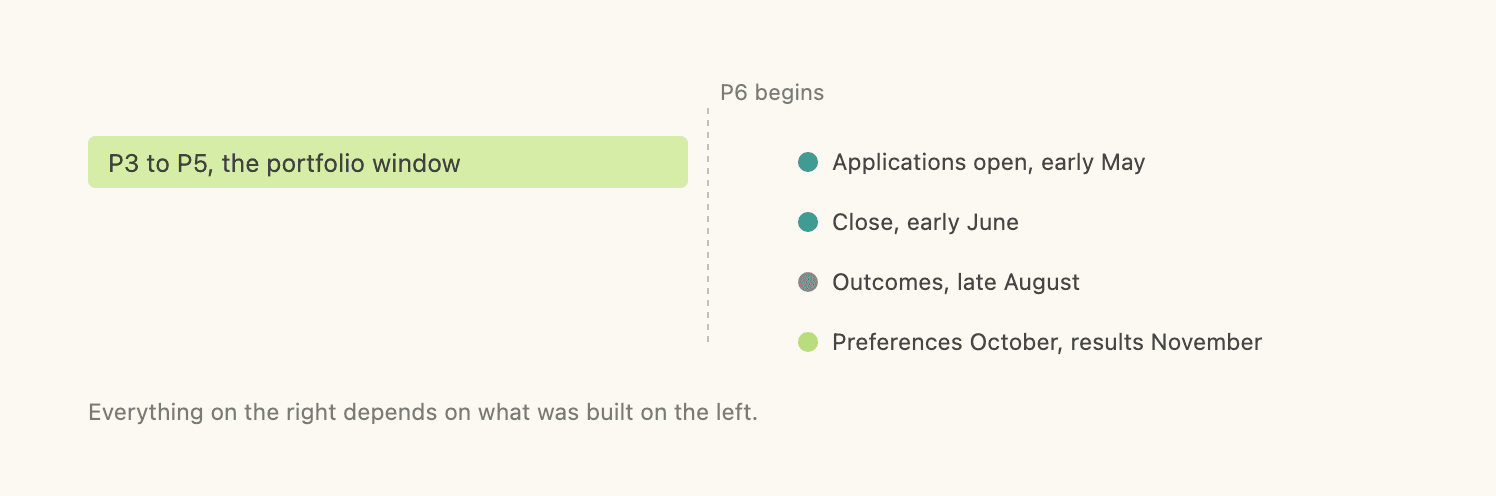
Dates from MOE DSA-Sec, 2026 exercise. Check the current year's calendar before planning.
Applications are made in P6. That single fact settles the rest.
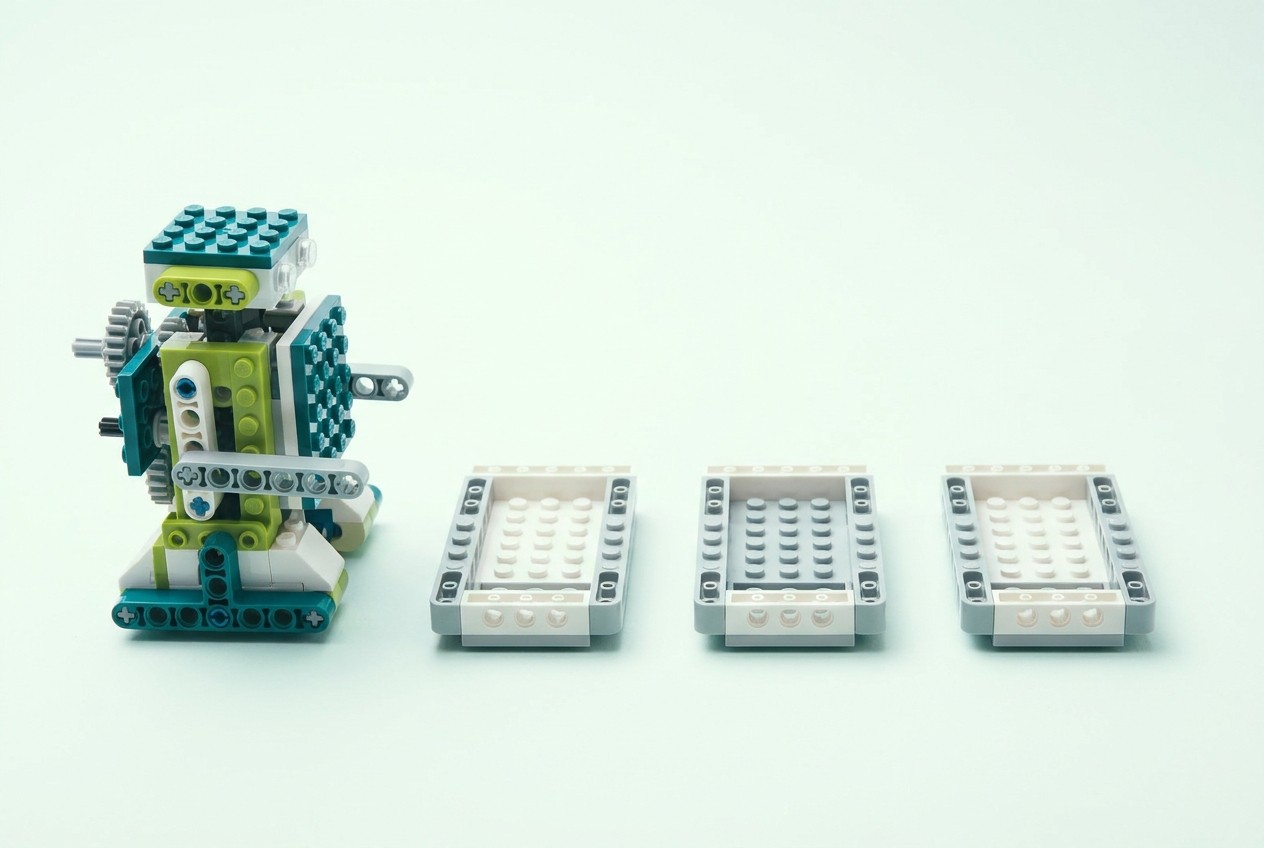
If the application happens in P6, the evidence behind it was accumulated before P6.
A child starting in P3 has three years. That is enough for a dozen or more finished builds, a competition season or two, and enough fluency to talk about a design decision without a script.
A child starting in P5 has one year. Workable, and it will show as one year.
A child starting in P6 has a hobby, which is a perfectly good thing to have. It reads as a hobby, because everyone reviewing applications has seen hundreds of them.
None of this means starting late is pointless. It means knowing which of the two you are buying, and both are worth having.
Our reading of what schools weigh, based on what MOE publishes about the scheme and what families tell us afterwards. Treat it as informed, not official.
Finished things. A robot that works, a program that runs, a project presented to an audience. Completion matters more than ambition.
A record over time. Two years of steady work reads differently from six intense months, even at the same volume.
Competition participation. Helpful, not decisive. The National Robotics Competition has run since 1999 with MOE support and takes children from age seven (Science Centre Singapore).
The child's own voice. This is the one families underestimate. A child who can explain why they geared a robot down, unprompted, is more convincing than a folder of certificates.
That last point is why we assess and certify at every level rather than only at the end. Not for the certificate, but because explaining your own work is a skill that needs practising.
Both sit under the same talent area, and the honest answer is that it depends on the child rather than the admissions odds.
Robotics produces physical, demonstrable artefacts and forces a child to separate a mechanical fault from a logical one. It photographs well and demonstrates well.
Coding goes deeper into language and abstraction sooner, and produces work that is easier to share but harder to show in a room.
Most children we teach do both, because the robotics work leads naturally into the code that drives it. If your child has a clear preference, follow the preference. Interest sustained over three years beats a strategic choice abandoned after one.
What it actually looks like, against our own ladder of six levels, 48 lessons and 96 contact hours.
P3. Levels 1 and 2. First working robots, then robots that use sensors. The child learns that a failed run is information. No competitions yet.
P4. Levels 3 and 4. Their own reusable code, gear ratios, multi-part builds. First competition entry if they want one. This is where a portfolio starts to look like one.
P5. Levels 5 and 6. Mission work, consistency under time pressure, a capstone project they choose. A second competition season, and practice explaining their own builds aloud.
P6. Application year. Consolidate, do not start.
Our competition track sits alongside this for families going that route, and the robotics programme is the ladder itself.
Worth being plain about, because the category is not always.
We build the pathway, the record and the practice at explaining it. We cannot deliver a place, and no centre can. Schools decide, on criteria we do not set, and any provider promising you a DSA outcome is selling something they do not control.
DSA is also not the only route. Most children enter secondary school through PSLE and are entirely fine.
Then almost none of the above applies to you.
Starting at nine or ten costs your child nothing. There is no developmental deadline, and the research on robotics does not support one. The DSA calendar is the only genuinely time-sensitive thing in this whole subject, and it only binds if you are actually applying.
Plenty of children in our classes will never submit a DSA application. They are there because they like building robots, which remains the best reason.
About Champs Robotics. We teach LEGO robotics, coding and AI literacy at 12A Kensington Park Road, Serangoon Gardens. Our pathway runs six levels, 48 lessons and 96 contact hours, with an assessment and a certificate at each level.
What age should kids start coding, and why the DSA clock starts in lower primary
AI literacy for kids, where the certificate is often a first portfolio entry
What robotics classes cost in Singapore, including competition tracks
In a free trial, your child builds and codes with an instructor beside them, and you sit in and watch a real lesson. Book a free trial class and see whether they finish what they start.
Does robotics help with DSA? Yes. MOE lists science, mathematics and engineering among DSA-Sec talent areas, and robotics sits inside that. It produces the evidence panels weigh: finished builds, a record over years, and a child who can explain their own work. It strengthens an application rather than deciding one.
Is coding accepted for DSA? Yes, under the same talent area. Whether robotics or coding suits your child better is a question about the child, not about admissions odds.
Do we need to win a competition? No. Participation helps, and sustained work a child can explain helps more. Plenty of strong portfolios contain no trophies.
Is P6 too late to start? For a DSA portfolio it is tight, because applications open in early May of P6 and a few months of work reads as a few months of work. For learning robotics it is not late at all. P3 gives the full three-year runway.
When do DSA applications open? Early May, closing early June, with outcomes by late August. The 2026 exercise ran 6 May to 2 June. Check MOE for the current year before you plan around it.