Benefits of Robotics for Kids: What the Evidence Shows

The strongest evidence for children's robotics is in computational thinking, and a 2024 meta-analysis found a large positive effect across every study it pooled. The claims about better maths grades, improved school performance and future-proofed careers are far weaker, and often have no supporting research at all. This is an unusual thing for a robotics centre to publish. We think you should be able to tell the difference before you spend money, including with us.
Below: three tiers, sorted by how much weight the evidence actually carries.
In short
Well evidenced: computational thinking. A 2024 meta-analysis found a large effect across all ten studies it pooled.
Plausible but thin: persistence, spatial reasoning, teamwork. We see them; we can't cite them.
Oversold: better school grades, future-proof careers, "falling behind". Ask any centre claiming these for a source.
Checkable and specific to Singapore: the NRC competition ladder and the DSA pathway.
This is the claim that holds up.
A 2024 meta-analysis in Heliyon pooled ten studies of educational robotics and computational thinking in early childhood. It found a standardised mean difference of 0.93, a large effect, with a 95% confidence interval from 0.60 to 1.27, and all ten studies pointing in the same direction (Alonso-Garcia et al., 2024, Heliyon 10(13), e33249).
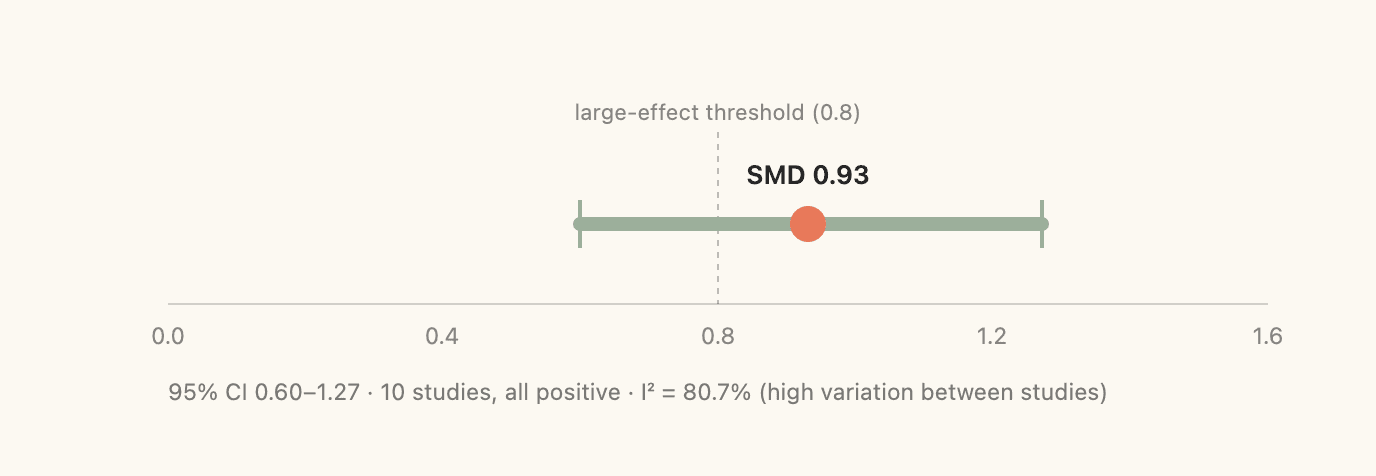
Two caveats the authors themselves raise. Ten studies is a modest pool. And heterogeneity was high (I² = 80.7%), meaning the size of the benefit varied considerably between studies. The direction is consistent; the magnitude depends on how it's taught.
Computational thinking means breaking a problem into steps, spotting patterns, ignoring what doesn't matter, and building a method that works every time. MOE ranks these skills above programming itself. A 2020 parliamentary reply named the focus as "computational thinking, problem solving, logical reasoning and data handling" (MOE, 4 Sep 2020).
So the best-evidenced benefit of robotics is also the one the Singapore system explicitly values. That is a genuinely good alignment, and it is the honest headline.
Related, and visible in any robotics classroom within about three weeks.
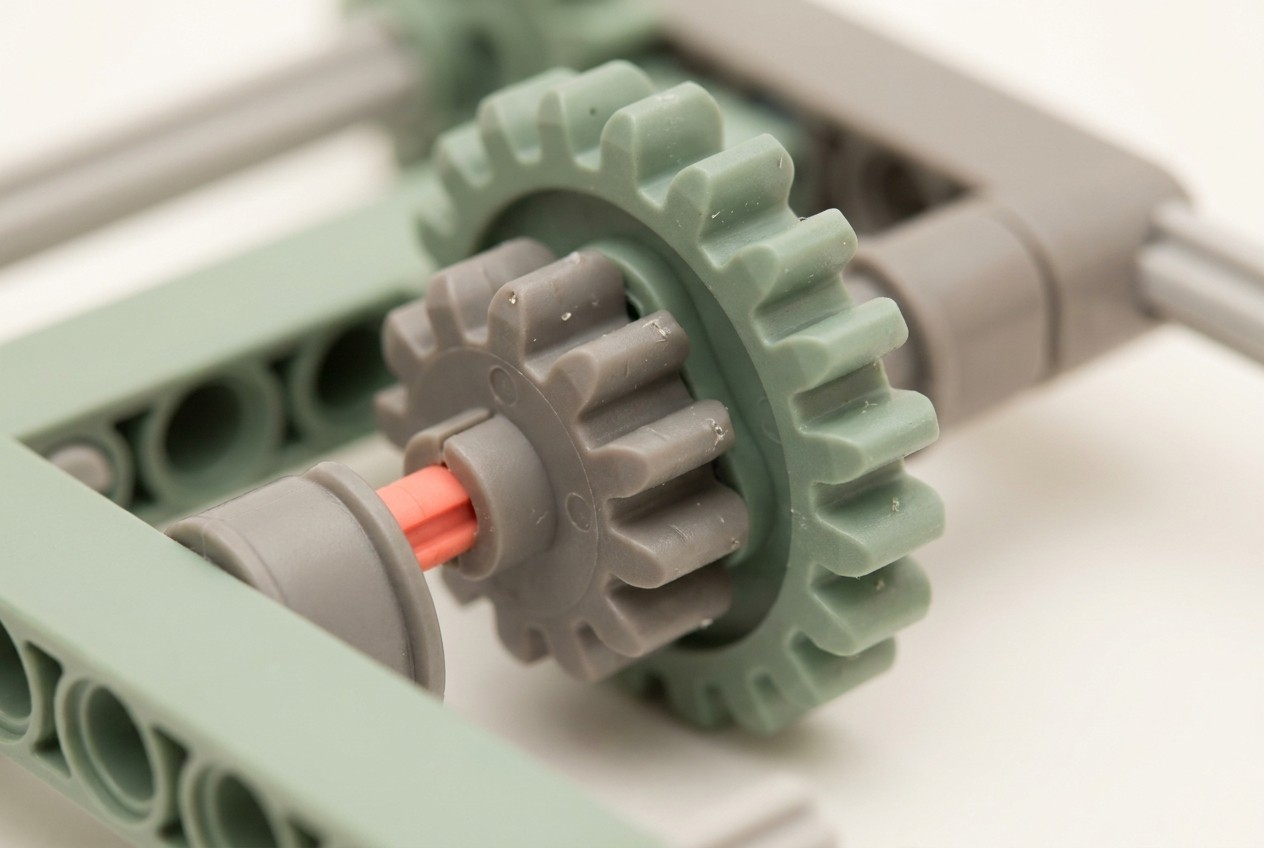
A robot turns 90 degrees on the bench and 78 on the competition mat. That forces one question: is this a building problem or a coding problem? The child has to change one thing, then run it again.
We watch this shift happen. Early on, a child whose robot misses its target rebuilds the whole thing. By Level 3 or so, they check the gear ratio first, then the code, then the surface. That is a transferable method, and it is taught by the material rather than by a teacher saying it.
We'd call this well-supported by direct observation and consistent with the computational-thinking finding, though we're not aware of a robotics-specific trial isolating it.
These are benefits we see, and believe in, without being able to point you to strong causal research on robotics specifically.
Persistence with hard problems. A robot gives instant, blunt feedback. It works or it doesn't, and it does not care how the child feels about that. Over a term, most children get visibly better at sitting with a failed attempt. Whether that carries beyond the robotics room is the question the research hasn't settled.
Spatial reasoning. Building a gearbox from a diagram is a spatial task, and spatial reasoning is known to be trainable. The step from there to "LEGO robotics improves it measurably" is reasonable, but not something we can cite for you.
Collaboration and technical explanation. In a competition team, roles split up. A child has to describe a mechanism clearly enough for someone else to change it. This is real, and it is the skill that shows up most in a DSA interview. It comes from how the class is run, though, not from robotics itself. A good group project in any subject would do much the same.
Maths and physics made concrete. Gear ratios are ratios. A robot travelling a set distance is a rate problem the child can see. Whether that transfers into better performance on a maths paper is a much bigger claim, and one we address below.
Where the industry, ours included, tends to get ahead of itself.
"Robotics improves school grades." We are not aware of good evidence that children's robotics raises attainment in maths or science at school. The computational-thinking gains are measured on computational-thinking instruments, not on school assessments. If a centre tells you robotics will lift your child's maths results, ask what they're citing.
"It prepares them for jobs that don't exist yet." Nobody knows which jobs will exist. That is what makes the claim impossible to disprove, and useless to you. The modest version: habits like breaking down a problem, trying again, and finding the fault are durable. They are unlikely to become less useful.
"Early exposure is essential or they'll fall behind." Singapore's own structure argues against this. Code for Fun gives every primary student around ten hours of foundational coding covering variables, loops and functions, with AI for Fun electives added from 2025 (MDDI, 1 Oct 2024). No child is excluded from the baseline. Enrichment adds depth; it doesn't rescue anyone from falling behind.
"It builds confidence." Probably true and almost impossible to attribute. A child who finishes a difficult build feels good about it. So does a child who lands a difficult piece of music. The confidence comes from finishing hard things, and robotics is one of many ways to do that.
Set the developmental claims aside for a moment, because there is a concrete, checkable benefit that has nothing to do with cognition.
Robotics has a national competitive structure and a school-admission pathway attached to it.
Science Centre Singapore has run the National Robotics Competition since 1999 with MOE support, drawing more than 68,000 participants to date, with divisions from Preschool through Tertiary (Science Centre Singapore). MOE also lists "science, mathematics and engineering" among the DSA-Sec talent areas (MOE). The 2026 exercise ran from 6 May to 2 June, with outcomes issued by 28 August.
Very few enrichment activities offer both. A graded competition ladder a child can climb from age seven, and a recognised route into secondary school at the end of it.
This benefit is real and checkable. It rests on no contested claim about child development. For many parents it is the deciding one, and that is a sound basis. It also has a timeline. A portfolio built across lower and middle primary carries far more weight than a P6 sprint.
Claim | Evidence | What we can say |
|---|---|---|
Computational thinking | Meta-analysis, 10 studies, SMD 0.93 | Well supported, with variation by teaching |
Debugging habit | Direct observation, consistent with above | Confident, not independently trialled |
Persistence, spatial reasoning, teamwork | Indirect | Plausible; we can't cite robotics-specific proof |
Better school grades | None found | Don't believe it |
Future-proof careers | Unfalsifiable | Meaningless as a promise |
NRC and DSA pathway | MOE and Science Centre Singapore | Verifiable fact, not a claim about children |
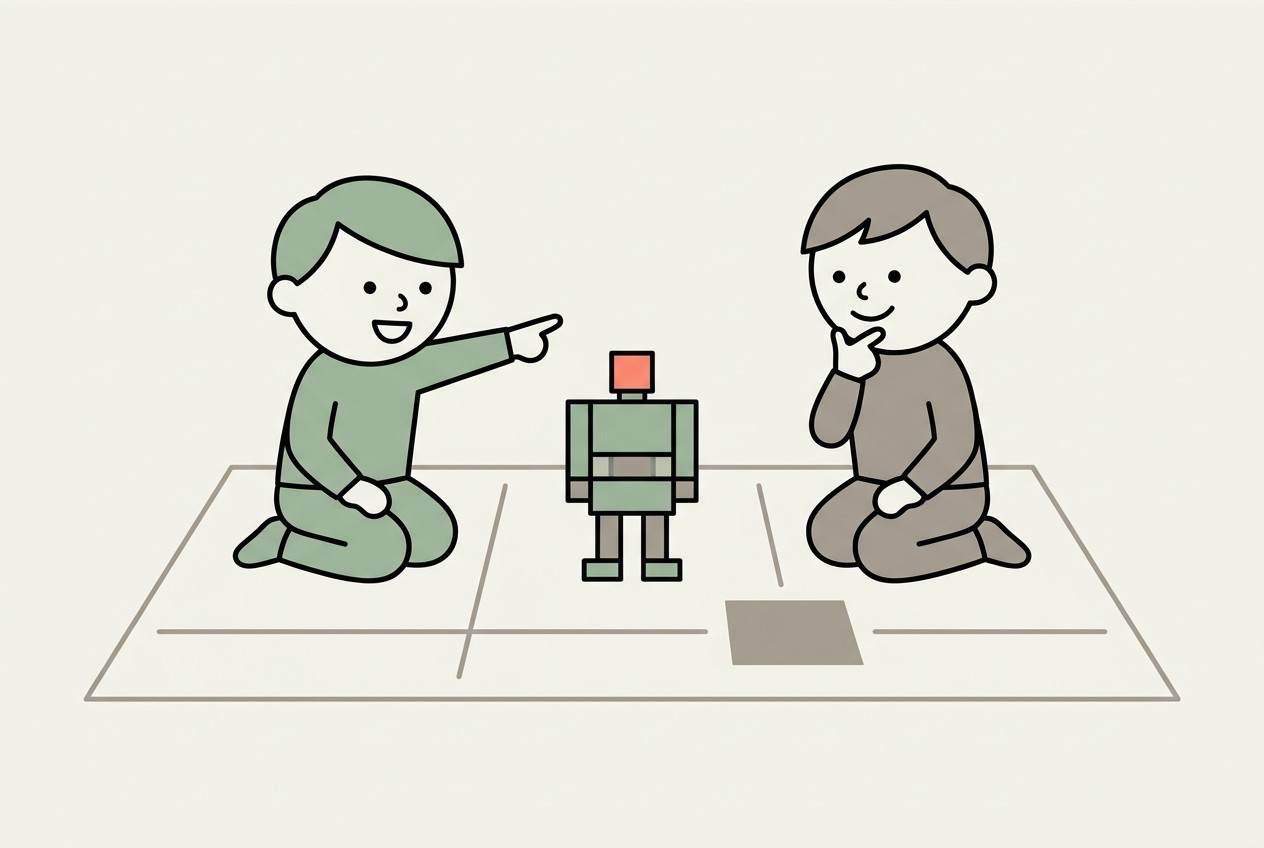
The meta-analysis finding on heterogeneity is the practically useful one. Benefits varied widely between studies, which means the how matters more than the whether.
From what we see, the factors that decide it:
Whether the child is building or watching. In a class that's too large or too fast, weaker builders end up spectating while a confident child does the work. They are present for the whole term and get almost nothing.
Whether failure is allowed to happen. A teacher who fixes the robot rescues the lesson and removes it. The productive moment is the child sitting with a robot that doesn't work.
Whether there's a ladder. Repeating introductory material in new packaging feels like progress and isn't. Our own pathway runs six levels, eight two-hour lessons each, each ending in a written and practical assessment. That's deliberate, so a child can't drift.
Whether the child wants to be there. The strongest predictor, and the least discussed. A reluctant child in a good programme learns less than a keen child in a mediocre one.
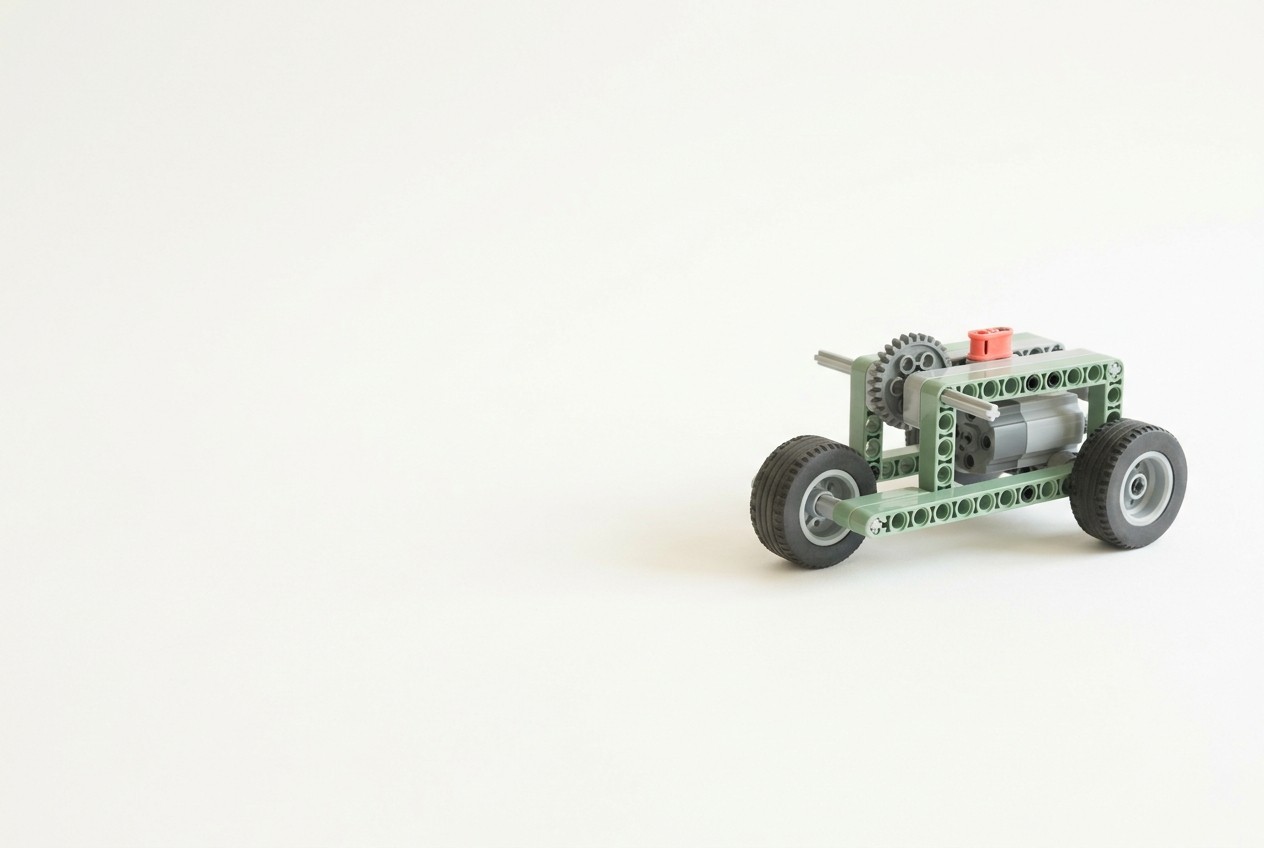
If you want the best-evidenced reason: computational thinking, which is well supported and directly aligned with what MOE says it values.
If you want the most concrete reason: the NRC and DSA pathway, which is checkable and unique to this activity.
If a centre offers you better grades, future-proof careers, or a warning that your child is falling behind, ask for the source. Including if it is us on a bad day. There usually isn't one.
The best way to judge any of it is to watch your own child in the room for an hour. Our free trial class at Kensington Park Road is free and unpushed, and an hour of watching beats a page of claims.
About Champs Robotics. We run LEGO robotics, coding and 3D printing at 12A Kensington Park Road, Serangoon Gardens. Our robotics pathway runs six levels, 48 lessons and 96 contact hours, from first build to competition-capable.
What age should kids start coding, and why the DSA clock starts in lower primary
LEGO robotics for kids in Singapore, including costs and the 2026 kit changes
Our competition track, the one benefit you can actually check
Robotics and coding for DSA, and why the portfolio is built in P3 to P5
AI literacy for kids, and what MOE covers at school
We've told you what we can't prove. The part we're confident about is easier to see than to argue, so come and look. Book a free trial class and watch an hour of it.
What is the main proven benefit of robotics for children? Computational thinking. A 2024 meta-analysis in Heliyon found a large positive effect across ten studies, though with high variation depending on teaching approach.
Does robotics improve a child's maths results? There is no good evidence that it does. Robotics makes mathematical ideas like ratios and rates concrete, but measured gains are in computational thinking rather than school attainment.
Is robotics better than coding classes? They teach overlapping things. Robotics adds a physical layer. The child has to work out whether a fault is mechanical or logical, which a screen-only course cannot reproduce. Coding alone goes deeper into language and syntax sooner.
At what age do the benefits start? NRC opens its Lower Primary division at age 7, and most children handle sustained debugging from around 7 to 8. Ages 5 to 6 can benefit from introductory building and sequencing.
Does robotics help with DSA in Singapore? It can support an application under the science, mathematics and engineering talent area. Sustained work the child can explain matters more than any single competition result.